 Paulo Castellano
Knowledge Base Statistics and Trends for 2026
Explore the top knowledge base statistics and trends for 2026 to enhance support quality, boost productivity, and optimize customer experience.

In 2026, people can create full presentations with a single prompt, edit videos in minutes, or generate campaign images in real time. With easy tools and AI doing the heavy lifting, everything feels faster, sharper, and almost effortless. Convenience has become an expectation, not a bonus.
And this shift hasn’t just changed how we create but also changed how we ask for help. Whether you’re running a SaaS business, managing an ecommerce store, or leading a service brand, customers expect answers instantly. They don’t want to wait for a response or want to scroll blogs for hours to find an answer. That’s exactly where a knowledge base steps up. It gives users the power to find what they need, the moment they need it.
A great example? Pipeback. It's an AI powered knowledge base that you can customize in minutes. Simple to set up, easy to use, and packed with smart features that make information accessible faster than ever.
Stick around. In this blog, we’ve gathered the latest knowledge base statistics and trends for 2026 that reveal how customer expectations are shifting and how brands are keeping up. Dive in and see what the data says about the future of instant support.
Self-Service Adoption and Customer Expectations
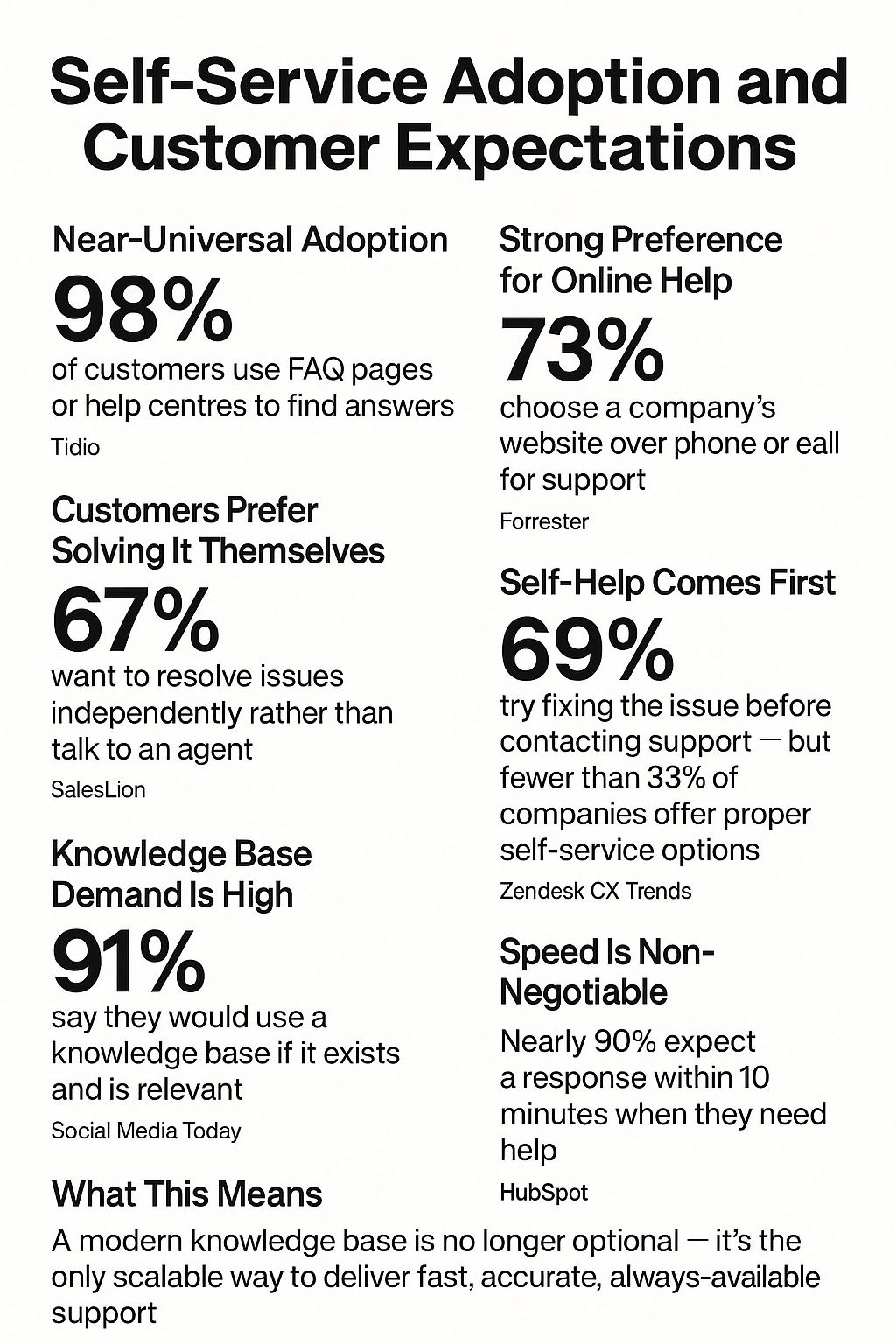
Customers today expect instant, effortless support and most prefer to find answers themselves rather than waiting on a response. The data paints a clear picture that service is a new norm today.
Here’s what the latest research shows 👇
🟩 → Near-universal self-service use: 98% of customers now rely on FAQ pages, help centers, or similar self-service tools on company websites to get answers.
Source: Tidio
🟩 → Preference for online support: 73% of customers would rather use a company’s website for help instead of phone or email support.
Source: Forrester
🟩 → Self-service over human interaction: 67% of clients prefer to solve problems independently instead of speaking to a representative. |Source: SalesLion
🟩 → Customers try self-help first: 69% of consumers attempt to fix their issue before contacting support — yet fewer than one-third of businesses offer proper self-service options like a knowledge base. That’s a major missed opportunity.
Source: Zendesk CX Trends Report
🟩 → High willingness to use knowledge bases: 91% of customers say they’d use an online knowledge base if it’s available and relevant to their needs.
Source: Social Media Today
🟩 → Speed matters most: About 90% of customers consider an immediate response — within 10 minutes — “crucial” when they need help.
Source: HubSpot
This rise in self-service expectations shows just how important a well-built knowledge base has become. It’s often the only scalable way to provide accurate, immediate support while keeping customers satisfied and engaged.
Business Adoption and Market Growth
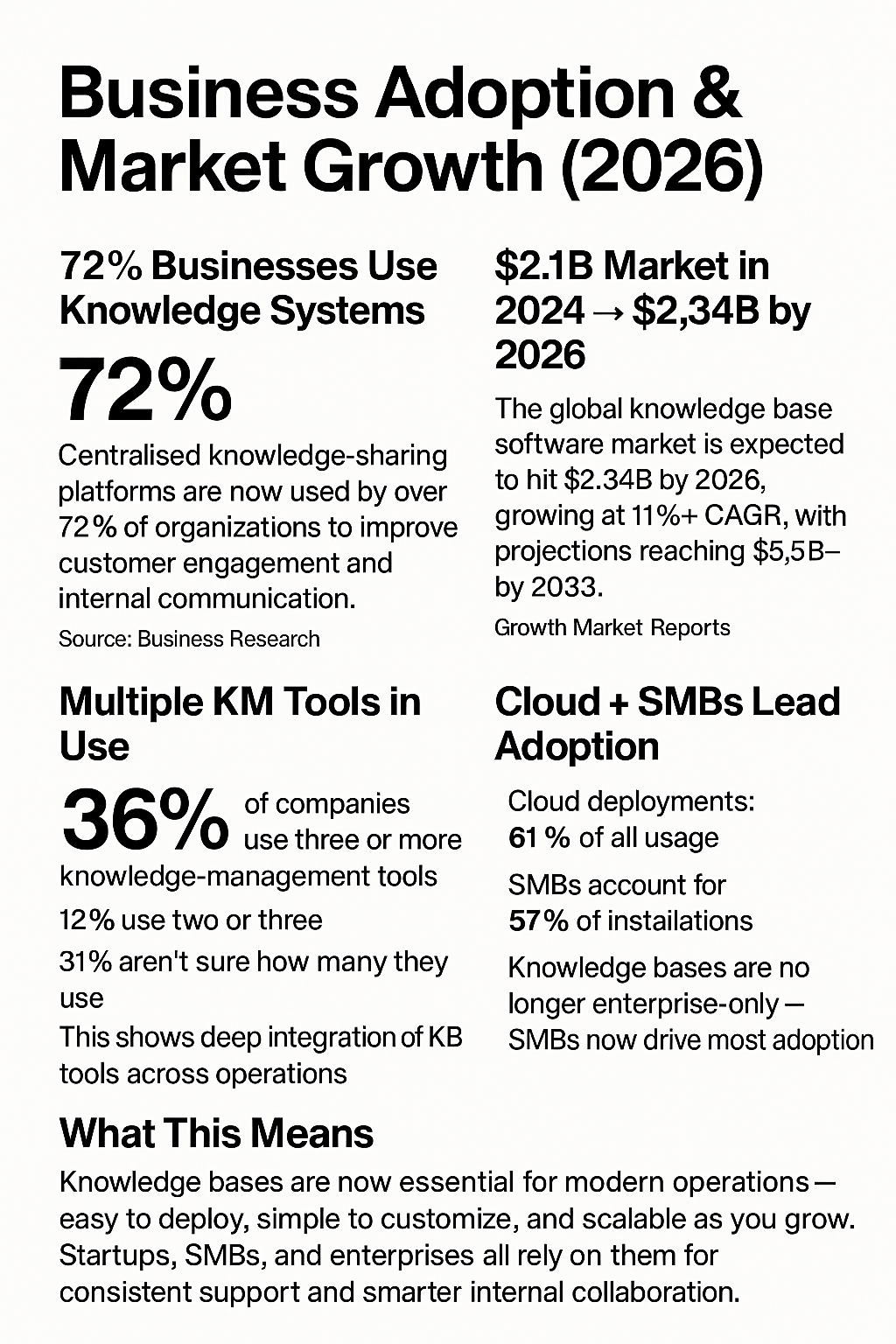
Knowledge bases aren’t just a customer support add-on anymore — they’ve become a core system for how modern businesses operate, share information, and scale efficiently. From startups to large enterprises, companies are embracing knowledge base software to meet rising customer expectations and strengthen internal collaboration.
Here’s what the latest numbers show 👇
🟩 → Prevalence of knowledge systems: Over 72% of organizations worldwide have adopted centralized knowledge-sharing platforms to improve customer engagement and streamline internal communication.
Source: Business Research Insights
🟩 → Use of multiple KM tools: According to a KMWorld survey, 36% of respondents said their company uses three or more knowledge management tools. Another 12% use two or three, while 31% aren’t even sure how many they’re managing — showing how integrated knowledge tools have become in business ecosystems.
Source: KMWorld / Livepro
🟩 → Global market size and trajectory: The global knowledge base software market was valued at around $2.1 billion in 2024 and is projected to reach approximately $2.34 billion by 2026 and over $5.5 billion by 2033, growing at more than 11% CAGR.
Source: Growth Market Reports
🟩 → Even higher projections: Some analyses forecast an even steeper climb — with growth around 16% CAGR, potentially pushing the market to $7–8 billion by the early 2030s.
Source: Business Research Insights
🟩 → Cloud and SME dominance: Cloud-based deployments make up about 61% of all knowledge base software usage, compared to 39% for on-premise systems. Small to mid-size businesses lead adoption with 57% of installations, while large enterprises account for 43% proving that these systems are no longer exclusive to corporate giants.
Source: Business Research Insights
This shows a clear pattern that knowledge base adoption is no longer limited to enterprise-level companies. Startups and growing mid-sized businesses are also investing in ready-to-use, customizable platforms that reflect their brand identity and can launch fast without heavy development. If you’re looking to explore options, check out top knowledge base software you can start using instantly to find one that fits your business goals.
Impact on Support Efficiency and Costs
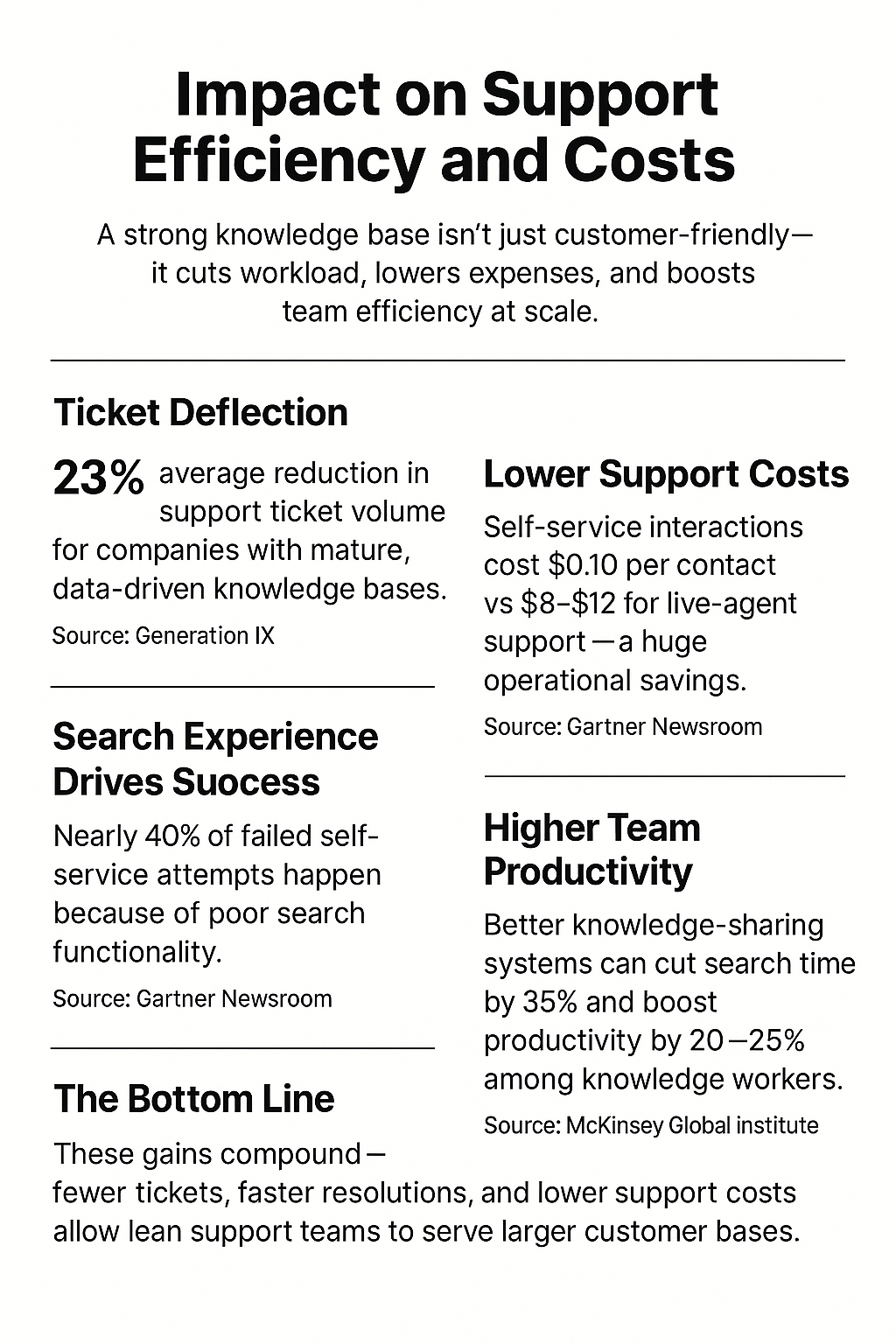
A well-built knowledge base doesn’t just help customers find answers — it transforms how efficiently a support team operates. From lowering ticket volumes to cutting operational costs, the numbers speak for themselves 👇
🟩 → Ticket deflection: Companies with mature, data-driven knowledge bases experience an average 23% reduction in support ticket volumes.
Source: Generation IX
🟩 → Lower support costs: Automated self-service interactions can cost as little as $0.10 per contact, compared to $8–$12 for live-agent interactions — a massive cost gap that makes self-service the most scalable support option.
Source: Gartner
🟩 → Search experience matters: According to Gartner, poor search functionality causes nearly 40% of failed self-service attempts in enterprise environments, proving that the quality of your knowledge base directly affects success rates.
Source: Gartner Newsroom
🟩 → Higher productivity: Implementing internal collaboration and knowledge-sharing systems can reduce the time employees spend searching for information by up to 35% and increase productivity among knowledge workers by 20–25%.
Source: McKinsey Global Institute
All these gains add up to strong ROI. Fewer tickets, faster resolutions, and lower support costs mean smaller teams can effectively serve larger customer bases which is a major reason why companies are doubling down on self-service knowledge platforms.
To dive deeper into how this works in practice, check out How Knowledge Base Reduces SaaS Support Tickets.
Customer Satisfaction and Retention Benefits
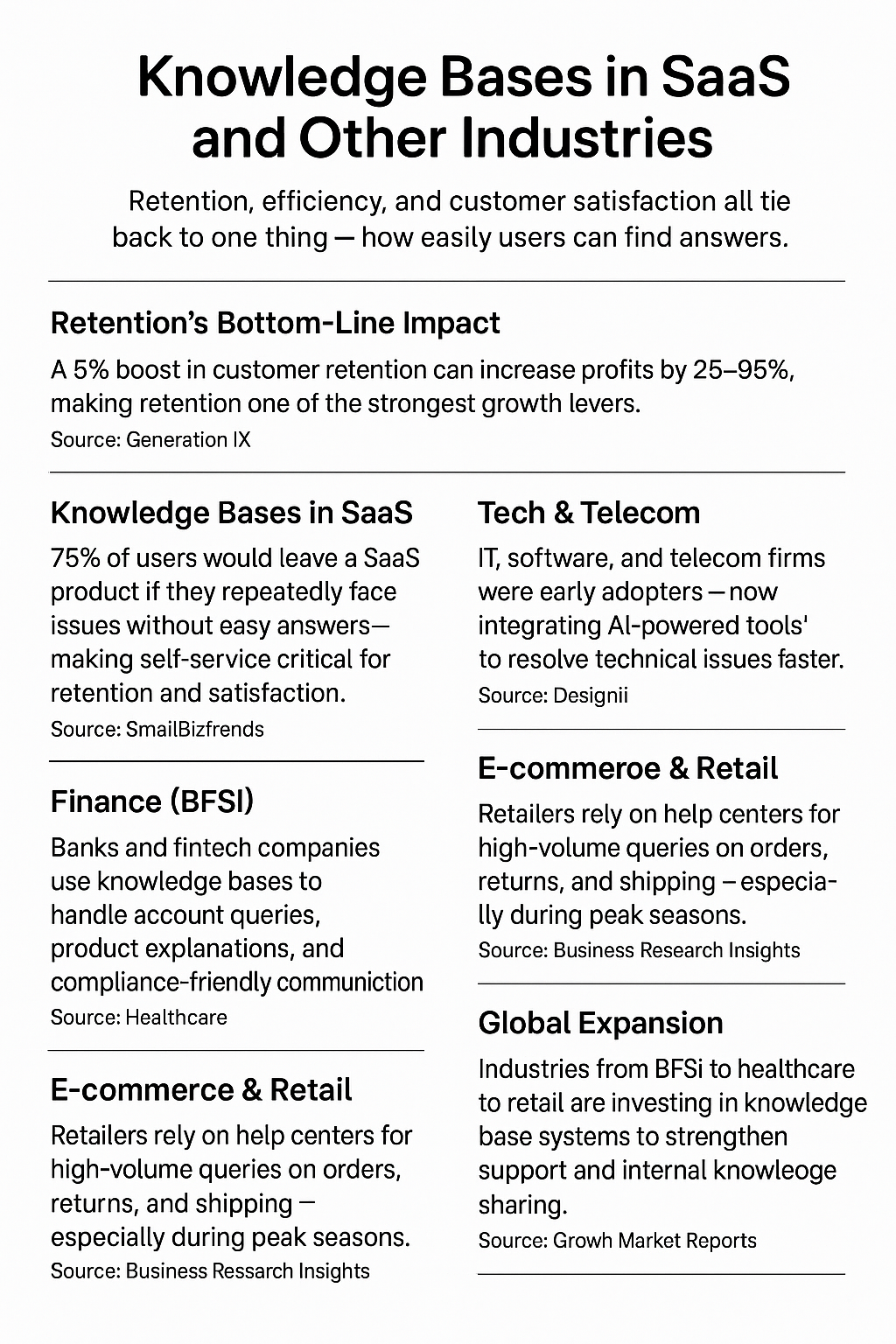
🟩 → Retention’s bottom-line impact: Even a modest 5% increase in customer retention can boost profits by 25–95%, making retention one of the most powerful growth drivers for any business. By preventing churn and keeping customers engaged through effective self-service support, knowledge bases play a direct role in driving revenue and long-term loyalty.
Source: SmallBizTrends
Don’t have a knowledge base on your website yet? Check out this guide on how to create a SaaS knowledge base. However, it's written for SaaS companies, but the same steps apply to any business looking to build a fast, reliable self-service system.
Knowledge Bases in SaaS and Other Industries
Knowledge bases have become essential infrastructure for scaling customer support — especially in the SaaS industry, where users expect instant, round-the-clock help. SaaS companies now depend on online help centers and in-app knowledge portals to onboard customers, provide self-service answers, and minimize one-on-one support requests. Nearly all leading SaaS firms maintain extensive knowledge libraries as part of their product ecosystem, helping cut costs and boost adoption.
🟩 → User retention in SaaS: A study found that 75% of users would quit a SaaS product if they repeatedly encountered issues without easy answers, highlighting how critical self-service tools are for customer satisfaction and retention.
Source: Designli
🟩 → Tech and Telecom: IT and software companies were among the first to implement knowledge bases — both for customers and internal IT helpdesks. Today, they continue refining these systems by integrating AI-driven tools to resolve complex technical issues faster.
🟩 → Finance (BFSI): Banks and fintech companies rely on public FAQs and customer knowledge bases to handle account queries, explain products, and maintain consistent information. This not only enhances customer clarity but also supports compliance and accuracy across channels.
🟩 → Healthcare: Hospitals, insurers, and medical networks use knowledge portals to give patients and call centers quick access to coverage information, services, and medical FAQs for reducing the burden on staff while improving accessibility.
🟩 → E-commerce & Retail: Online retailers use help centers to manage high volumes of repetitive questions about orders, returns, and shipping particularly during peak shopping seasons for reducing ticket overload and improving customer satisfaction.
🟩 → Education & Government: Universities and public agencies employ knowledge bases to publish policies, guides, and updates for students or citizens, cutting down administrative calls and improving communication efficiency.
🟩 → Widespread business adoption: In a 2024 U.S. survey, 74% of small and mid-sized businesses reported adopting digital knowledge management platforms to improve information access and customer interactions.
Source: Business Research Insights
🟩 → Global market expansion: Across industries from BFSI and healthcare to retail organizations worldwide are investing in knowledge base solutions to empower teams and enhance client support.
Source: Growth Market Reports
This trend makes one thing clear: knowledge bases are no longer industry-specific. Whether you’re in tech, finance, healthcare, or education, self-service support and internal knowledge sharing have become key to running efficient, customer-first operations in the digital era.
Knowledge Base Management Trends (2025–2026)
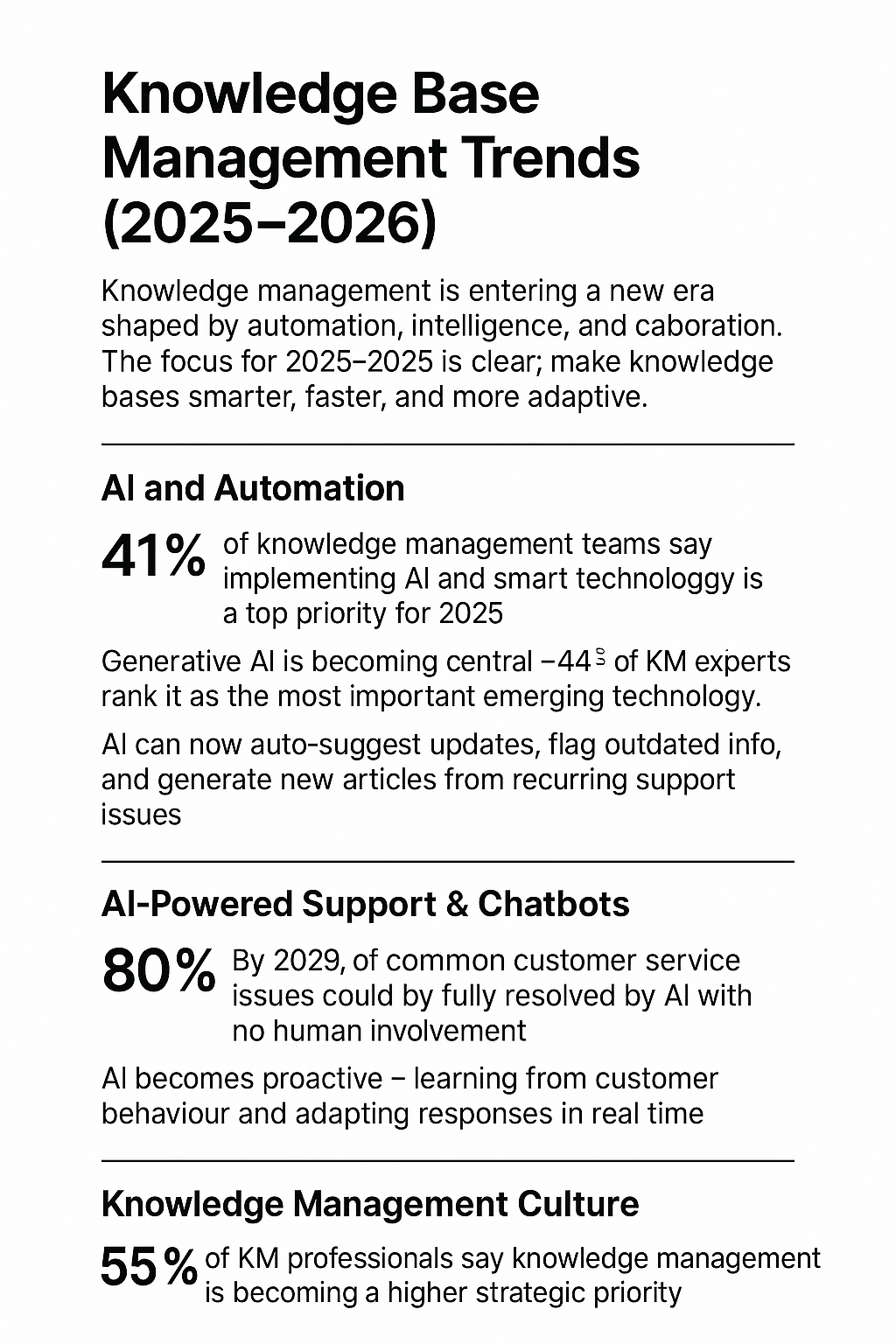
Knowledge management is entering a new era, one defined by automation, intelligence, and collaboration. As customer expectations rise and data multiplies, the focus for 2025–2026 is clear: make knowledge bases smarter, faster, and more human-aware.
🟩 → AI and Automation: The integration of AI continues to lead the charge in knowledge management. In fact, 41% of knowledge management teams report that implementing AI and “smart” technology is a top priority for 2025. Source: Cake.com
Generative AI, in particular, is reshaping how knowledge is created and maintained 44% of KM experts rank it as the most important emerging technology for the field.
Source: Cake.com
AI tools can now auto-suggest updates, flag outdated information, and even generate fresh knowledge base articles from recurring support queries. This evolution means less manual work, faster updates, and more accurate, contextual responses for users. For a deeper look at how AI is transforming customer support documentation, check out our post on AI-based knowledge bases and why your business needs one.
🟩 → AI-Powered Support & Chatbots: The future of self-service is increasingly autonomous. Gartner predicts that by 2029, 80% of common customer service issues could be resolved by AI (“agentic AI”) — without any human intervention.
Source: Gartner
This shift positions AI not just as a support assistant but as a proactive engine that continuously learns from customer behavior and tailors responses in real time.
🟩 → Knowledge Management Culture: Technology alone isn’t enough — culture matters just as much. Recent research shows that 55% of knowledge management professionals believe KM is gaining ground and becoming a higher strategic priority within organizations.
Source: Cake.com
Businesses are building dedicated KM teams, encouraging cross-department collaboration between support, product, and engineering, and treating their knowledge base as a long-term strategic asset rather than a static documentation library. This cultural shift ensures that knowledge remains current, consistent, and collectively owned.
The Bigger Picture: Together, these trends point to a more proactive and intelligent future for knowledge based systems that don’t just answer questions but anticipate them, adapt to new data, and continuously evolve. Companies that adopt AI-driven, culture-first knowledge management will lead the next wave of customer experience, especially fast-moving SaaS firms where instant, accurate information defines success. To explore practical applications of this evolution, check out how AI knowledge base software can help you scale your business.
Wrap Up:
If your business still hasn’t invested in a knowledge base, you’re missing out and so are your customers. Companies without one are falling behind, struggling to keep users engaged, and losing valuable time answering the same questions over and over again. Without an organized, searchable system, your support team works harder while your customers wait longer and in 2026, that’s not a good look.
A knowledge base changes everything. It helps your support team respond faster, keeps your customers self-sufficient, and strengthens your brand’s credibility. And the best part? You don’t need a big setup or a long onboarding process to make it happen.
With Pipeback, you get a knowledge base that’s easy to set up, simple to customize to match your brand image, and quick to manage that adds or editing articles takes just minutes. Plus, its AI-powered search makes finding answers effortless for users, helping both employees and customers get exactly what they need, instantly.
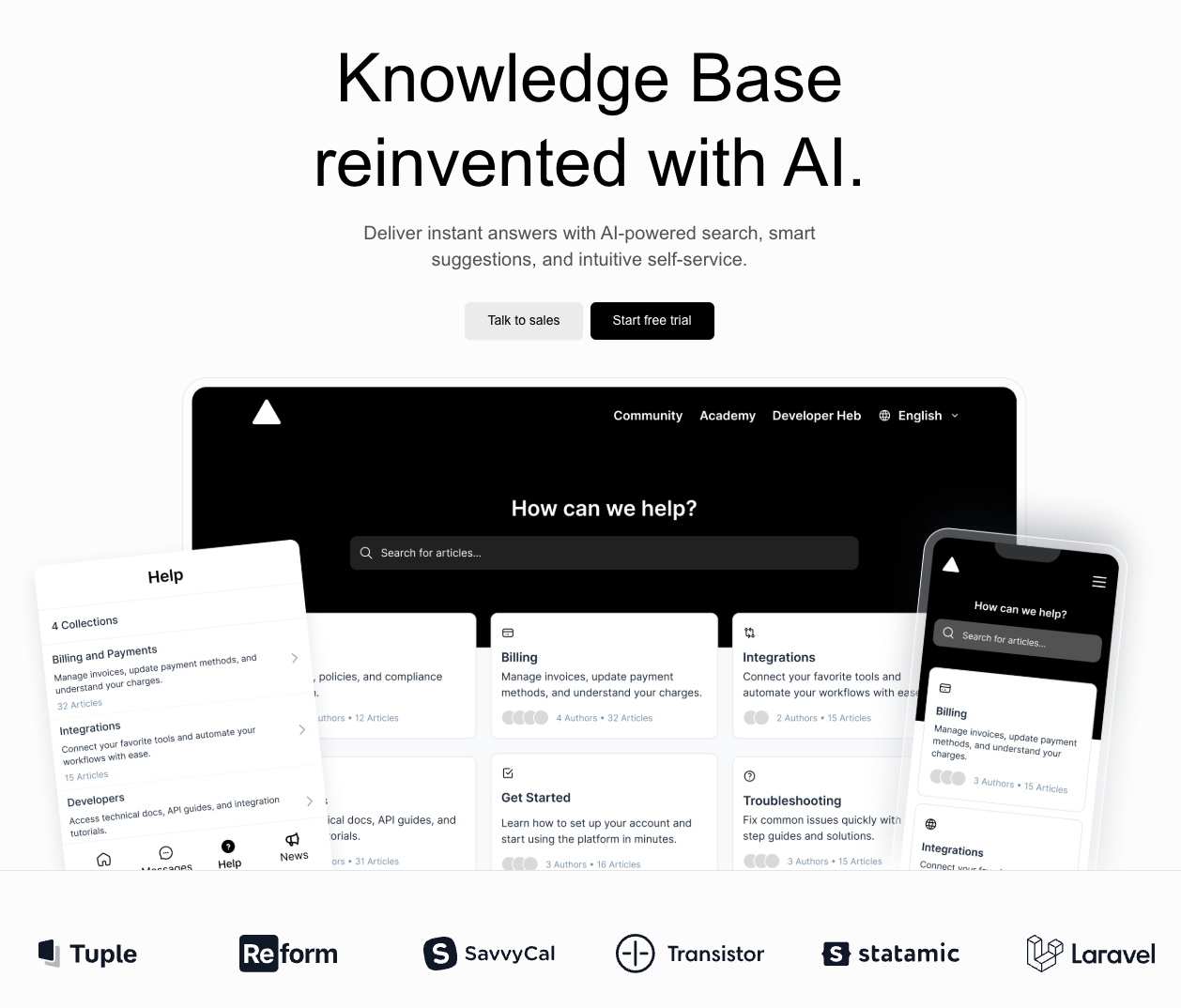
You don’t even have to put your money on the line. Start with a free trial, see how effortlessly it fits into your workflow, and decide for yourself after watching how it transforms your support experience.
Share this article